Paper cutting is a kind of art of paper design. Fold and cut are important steps of making paper-cutting artwork. With these steps, even simple shapes can generate fabulous artwork. In this assignment I created a set of instructions for the paper cutting:
1. Pick a square paper
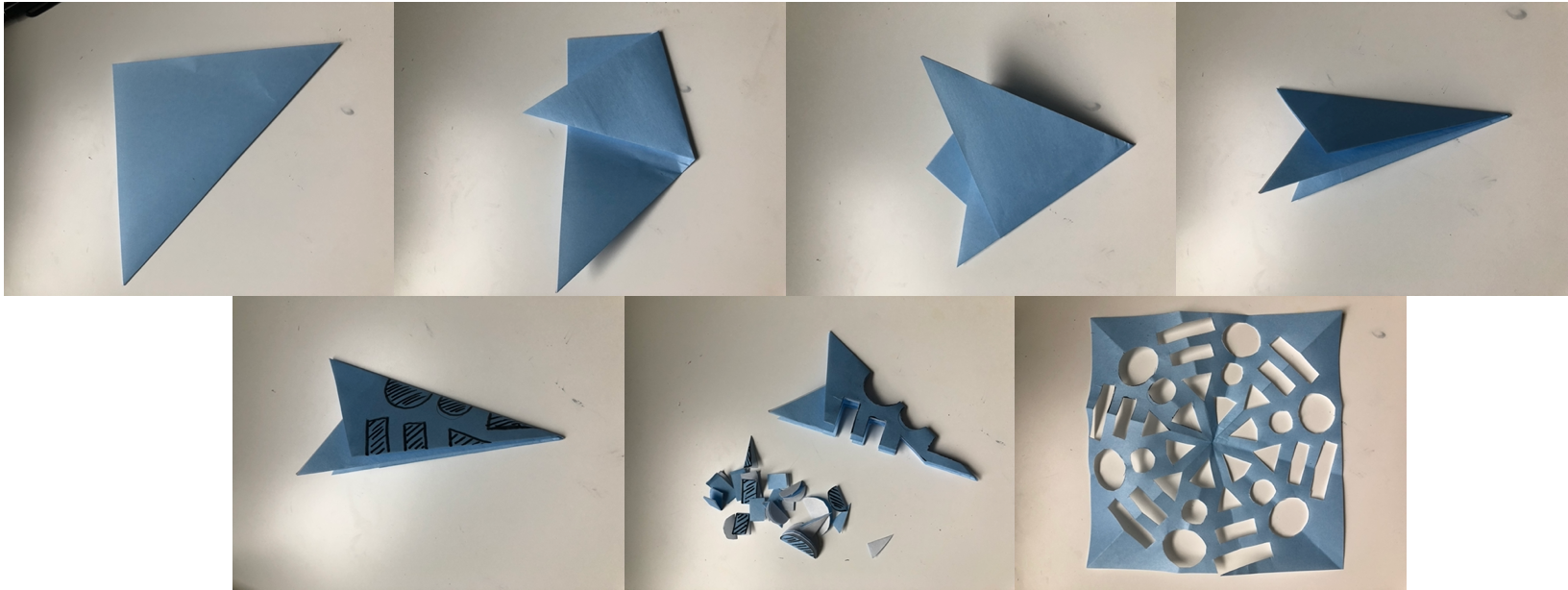
2. Fold the paper in whatever way you like, but you can only fold for at most 4 times.
3. Choose a face of your folded paper. Draw some rectangular, triangles, and semi-circles on the face. You can draw the shapes at wherever you like but for each shape, no more than two.
4. Cut off the shapes you drew on the paper.
5. Unfold the paper, now you have paper cutting work.
In the instruction, I’ve created some constraints like the max times that the creators should fold, the kinds of shapes that they can use, and also the max number of shapes. However, I also keep some freedom for creators. Like the way they fold and the place they would like to draw the shapes.
Following the instruction, I created these three artworks.


After sending instructions to my friends, I got their artwork like these.


All of them are surprised about the final work after step 5. One creator said that she had an idea about what she would like to create before starting the steps, but the final artwork is totally different from the result in her mind. The other creator did the work in a different way. He didn’t think about what the work would be like after each step but do whatever he like. But the final work still surprised him. He had never imagined that the artwork he created looked like a mushroom and he like the work he created.
In paper cutting work, the part we cut off were just simple shapes, but the folding step duplicated the simple shapes and make them into symmetric patterns. The combination of the different shapes makes it a creative paper artwork.
Some of the folded shapes reminded me of the first few folds of origami patterns. I also found it intriguing the way different folds resulted in different forms of symmetry.
When you were creating numerical constraints (4 folds, 2 of each shape, etc.) did you have particular reasoning behind the numbers, or was the exact number chosen somewhat arbitrarily?
I was struck by how well you were able to cut the smaller cuts. I have done a lot of work like this recently, and I know the small cuts are difficult.
How do you think the “2 of each shape” rule effect the final products?
I’m surprised that not all works are centrosymmetric. In rule 2, randomly folding, really makes the end result unpredictable. Unexpected results are more interesting, especially for those who didn’t envision it at first.
Do you think if you don’t tell them it’s going to be cut, let them fold first. And after they finished folding, tell them to cut. The results might be different?
These instructions produce such unpredictable works that are delicate and eye-catching, every work is different from the next, the way they work with light is stunning. How does one know if they should pre-plan how to cut the shapes versus waiting to see what happens? Are there times when the piece falls apart but is still visually interesting?
I love most about this set of rules because it can be done very quickly, individually or with others. The outcomes were surprising for many of them.
I was struck by how your examples resembled Mondrian’s Broadway Boogie Woogie. I have really enjoyed folding and cutting paper since I was little, though I was bounded by the idea that I had to have a perfect symmetry in the end. I cut snowflakes generally. Your ruleset and examples allowed and even challenged me to break out of that constraining mold and try something different. I love it. I felt more free to cut and create than I ever did as a kid. What was the inspiration for your idea?