Dungeons and Dragons is at its most fun when everyone is playing together in the same room with physical pieces to represent battle maps, characters, etc. The quality of these pieces can vary greatly. Enemy monsters can be represented with candy, 2D paper cutouts, or 3D plastic miniatures. Maps can be printed out works of art, or dry-erase markers on a compatible mat.
Using higher-grade materials tends to be exciting, but it can be difficult to accomplish for a number of reasons. Cost of these materials and resources when pre-made can be quite expensive, with some miniatures reaching hundreds of dollars. Additionally, D&D is improvisational by nature, and it can be unpredictable what types of resources will be needed at any given time. Ideally, everything will be prepared and ready at a moment’s notice.
For this project, I wanted to experiment with quick and easy mass-production of pieces for D&D. I chose to create one map and one method to represent characters. For the map, I chose to recreate an area that is frequently visited in a campaign I’m currently running.
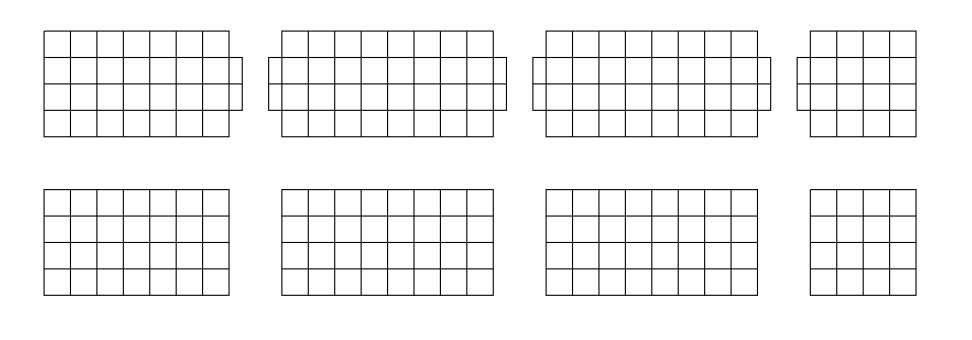
The above image is a grid that represents a series of interconnected train cars. The top row is the floorplan of the interior of the train, and the bottom row is the floorplan for the top of the train. I chose to keep the map simple so that I can keep it modular and adaptable. This map will be laser-cut out of wood and will replace the dry-erase version currently used in the game.
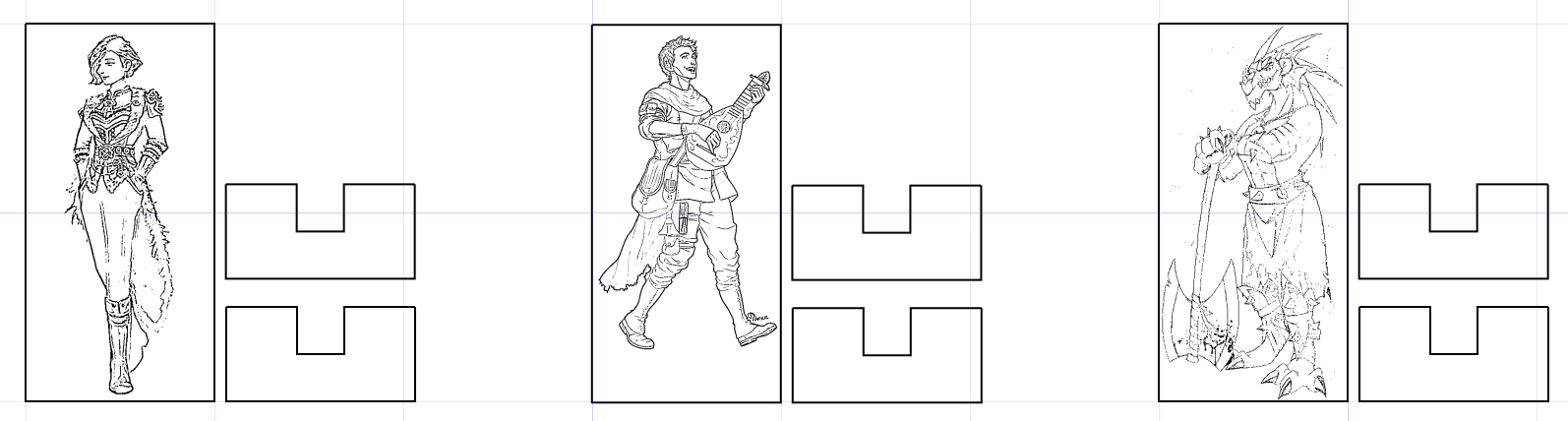
The next piece I wanted to make was a 2D cutout of a character portrait that could stand up, which could move around a map to indicate the location of the character. The above image shows three examples of this. I found artwork on Pinterest created by various artists to represent a handful of Non-Player Characters (NPCs) in the game. This is something that I frequently do, as it allows me to quickly prepare large quantities of interesting characters and allow existing art to serve as shared imagery for all of the players. For this project, I ran these portraits through a website that turned them into line-art, hoping that would make them compatible with the laser cutting process. The small U-shaped pieces next to the characters will serve as stands so that these 2D images can stand up on the map. The portrait cutouts should fit perfectly inside of the hole in the stands.
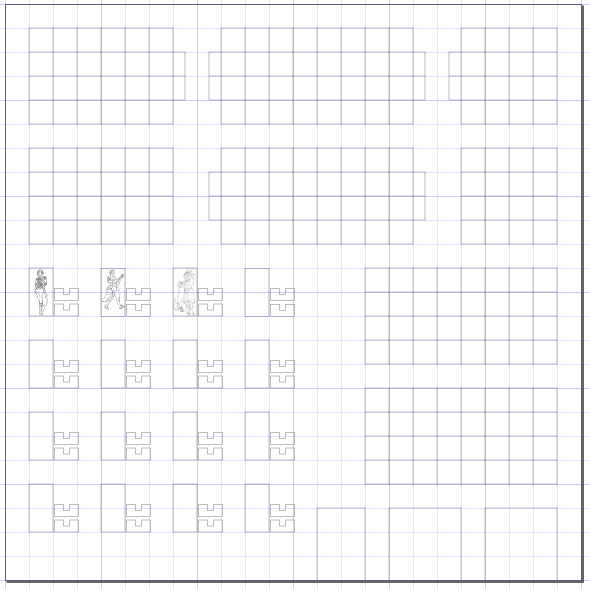
This final image is the layout for all of the pieces on the full-sized board. I decided to create extra, blank character pieces to experiment with other methods. I also created a few larger rectangles to play around with different sizes of character cutouts.