In my last post I outlined my main project idea being to put some sort of spin on the Infinity Cube concept. Since then I’ve narrowed the directions down on where I can take the idea considering both some of the feedback I got as well as cost constraints I encountered in my selection of materials. Some of my top two suggestions were to either go with my nested infinity cube idea or make the infinity cube double as a functional die for when I play Dungeons and Dragons. I really liked both these ideas, and my decision between them mainly boiled down to the cost of materials for making two entire infinity cubes was simply too much than I was willing to spend to, so I’ve decided to go with the second option.
For planning the design of my infinity cube, I decided to base my calculations on making an infinity icosahedron (or in D&D terms: D20) as if I’m going to go the route of making a functional die for D&D it might as well be the most iconic die. This means that I will need to line the inside of 30 edges with LED strips in order to light up the whole object. In terms of resolution I personally wanted 10 LEDs per edge in order to have more control programmatically to create an interesting music visualizer using the icosahedron. This meant I’d need a total of 300 LEDs, however since LED strips come in 144 LEDs per 1 m, I ended up reducing the amount of LEDs per edge to 9 so that I could have enough LEDs with just two 1m strips. The required edge length and surface area can be seen in the figure bellow.
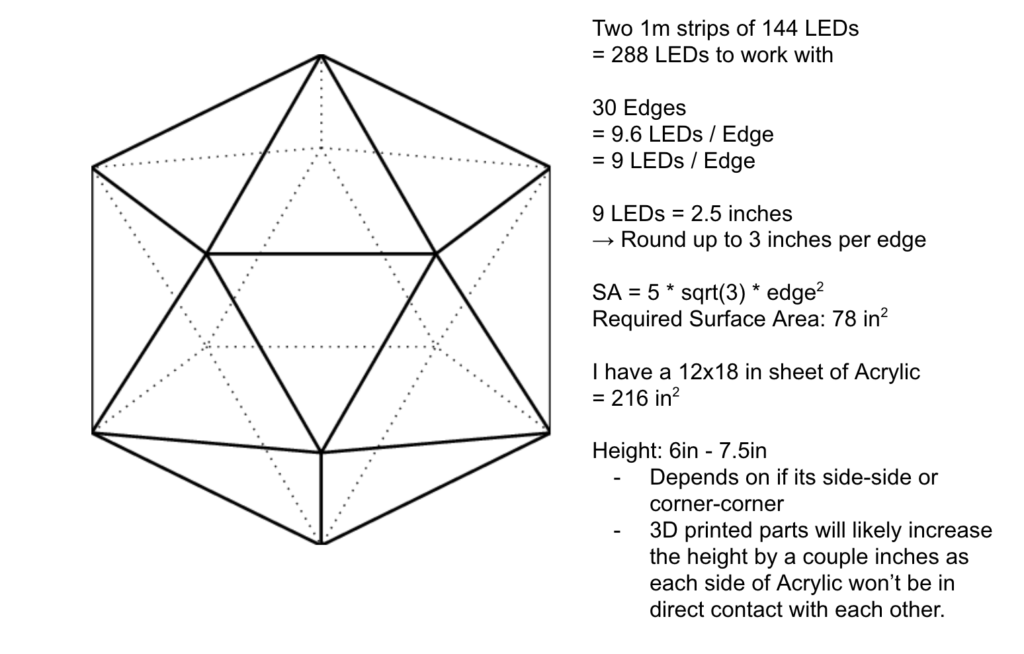
In terms of materials, as you can see in the table bellow I own or have on campus access to majority of the materials and tools that I need to functionally make the project. However I did need to buy the main two materials to physically make the infinity icosahedron: the LED strips and see-through acrylic mirror. Since I needed two 144p/1m LED strips to achieve the minimum icosahedron size I was aiming for, one infinity icosahedron ends up costing around $60 of this size. If I then also wanted to nest that icosahedron inside another, you can image that the second icosahedron would like be around $150 in material costs.
| Item | Item Cost | Total Cost |
| LED Strips (2x) | $20 | $40 |
| Acrylic See-Through Mirror (12×18) | $20 | $20 |
| Aux Cord (2x) | $5 | $10 |
| Arduino | owned | |
| Basic Electronics (wires, resistors, motors, etc.) | owned | |
| Arduino Sound Board | owned | |
| Tools for assembly (Soldiering Iron, 3D Printer, Laser Cutter) | own/access | |
| Speaker | owned | |
| 5V Power Supply | undecided |
Finally since my LED strips arrived before this last weekend, I was able to start prototyping some ideas for how to control the LEDs as if they were different sides of the icosahedron to visualize music. Using my Arduino Sound Board I can split incoming frequencies into 7 channels, so I started with a simple Hello World test where I just lit up a different LED depending on which of the 7 channels was the loudest. From there I worked my way up to having 7 “edges” corresponding to the 7 channels, each with 9 LEDs. Then for each channel I measure how loud it is, and depending on its loudness level I light a corresponding set of LEDs (I currently have 10 loudness levels). From here its fairly simple to either add more loudness levels, or change how the LEDs behave at each loudness level, and these decisions will come later once I have the infinity icosahedron assembled and I see for myself what the effects look like and adjust from there.


Planning ahead, my general timeline for when I want to complete parts of the project by is:
| Goal | Date Completed |
| 3D CAD Model Complete Start 3D Printing Parts Laser Cut Acrylic Sheet | Sept. 28 |
| Finish 3D Printing Parts Assemble the infinity icosahedron | Oct. 2 |
| Finish programming music visualizer Program some sort of D20 dice rolling animation | Oct. 5 |
| Any last debugging / adjustments Final Demonstration | Oct. 12 |
| Final Documentation | Oct. 16 |
Being able to watch the lights live yesterday in class was awesome, will the acrylic you bought as the infinity mirror allow all colors of light to shine through or only certain ones? That might be something to watch out for.
It seems like you’ve done a lot of work already and that your final infinity cube will be very cool!! I like that you will be making it functional for dungeons and dragons, it’ll be awesome to play with!
It’s impressive that you did the math for this project and I think having just one dice will still make for a very interesting project. I like that you’re adding an interactive sound component to this project. Excited to see how it turns out!
I think that this is going to be a pretty funny die to see and “roll” especially considering its size. How are you planning to attach the pieces of acrylic together and then the LED strips to the sides?
This is a great start to the project.
Once it’s together, you’ll have some interesting decisions to make in terms of how you choose to translate the audio analysis info into visual patterns.
You have plenty of tech to grapple with already, so think of this as an “icing on the cake” suggestion, but it would be cool to have the system respond to being “rolled.” A fancy way to do this would be with an accelerometer and/or gyro, but you could probably get away with something much simpler like a rolling-ball tilt switch.
https://www.sparkfun.com/products/10289