One of the board games I played with my family a lot when I was younger was Chinese Checkers (or Stern-halma). It’s a 2-6 player game and sorta has the same rules as regular checkers with a few exceptions. For this project I wanted to recreate my own board for 2-6 players. In the past I had made a 2 player board with my dad and this project brought back that memory. To give it my own special twist, I made the board and pieces all inspired by science as it is a huge part of my life (can you tell I’m a biochemistry major?). As you can hopefully see below, the board is modeled after Rutherford’s atomic model, and all of the pieces are modeled after pieces of lab glassware.

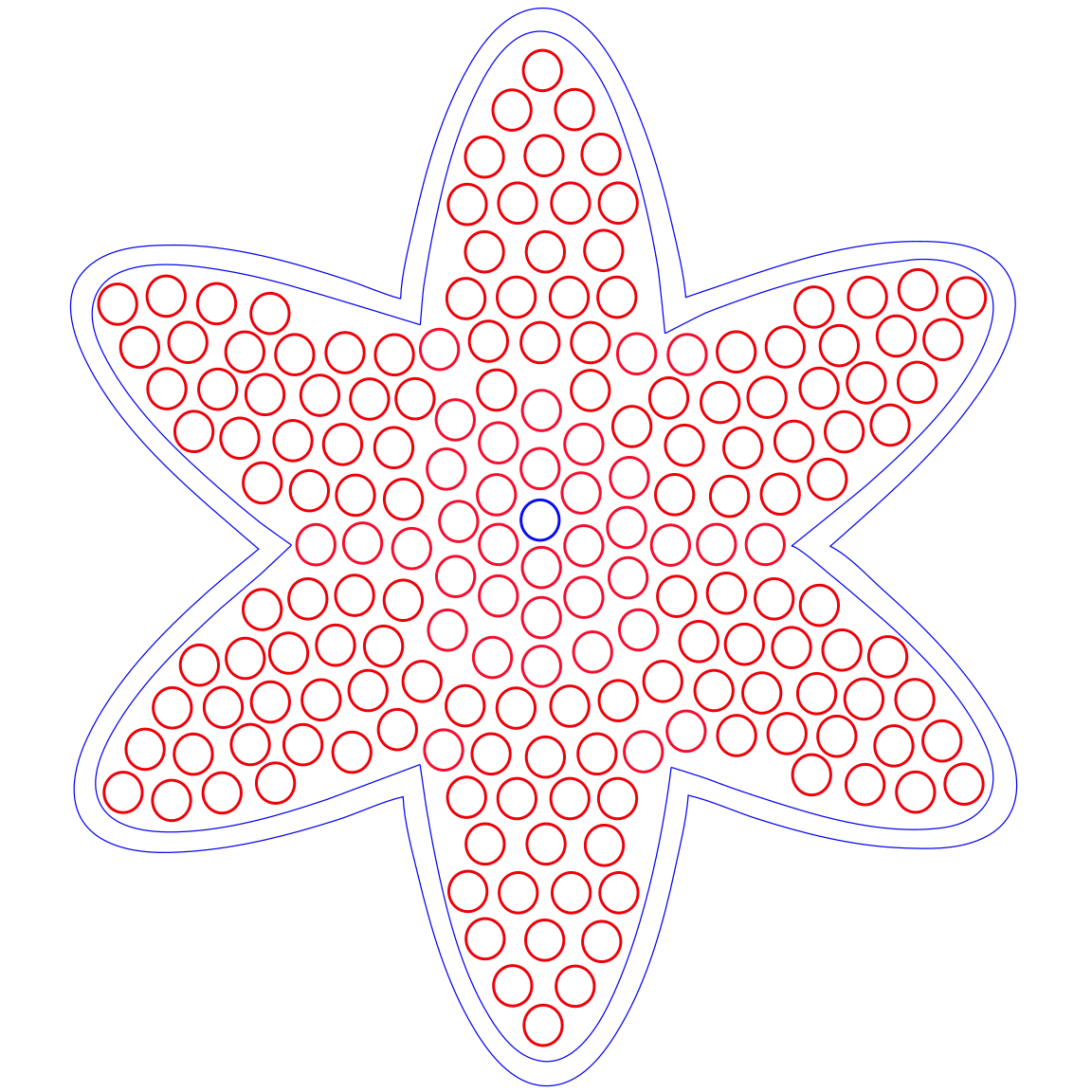
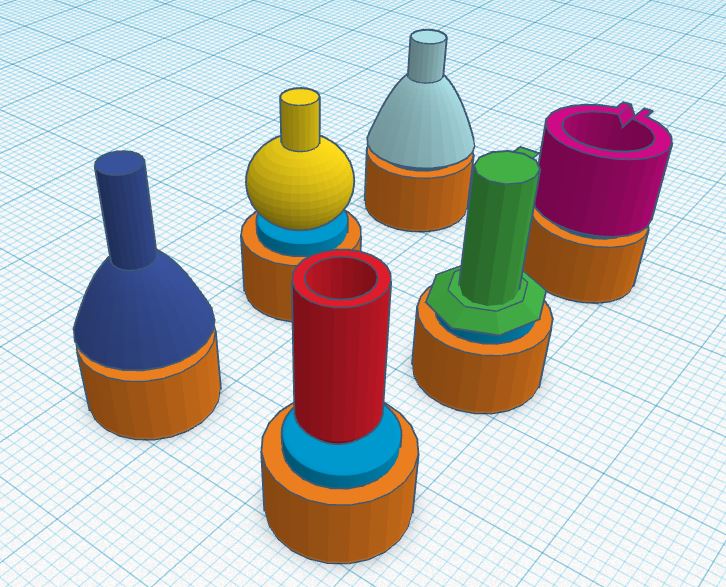
The holes in the board are roughly 11 by 12 mm rounds (roughly a cm), so the pieces were modeled to fit within those holes. The top glassware designs have various heights and widths as they will not have to fit into any part of the board. I’m hoping to make 9 pieces for each of the 6 designs so that there’s a possibility for the art piece to be functional as a game board. I will be using the laser cutter for the board and 3d printing the pieces!
Hi Lauren,
I think it is super creative to use both the laser cutter and 3D printer for your project. I think requesting a different color filament for each game piece would be really cool (if that is something you are open to)
Hi! I think if requesting different colors for each piece doesn’t work painting the pieces could be an option so then you could also add details to the glassware game pieces like the measurement lines.
Hi Lauren, this idea is so cool! Maybe you could paint the atomic model on the cut game board.
One idea for decorating the baseboard is to have two layers. A thin top one that you engrave with the Rutherford design before cutting out the holes. Then for the bottom one you also engrave the exact same design, that way when you place them on top of each other, the two designs will align, giving you the engraved pattern of the Rutherford atomic model on the baseboard. It also makes it so that the holes don’t go all the way through and instead of the table, you get to see the design.
Hey Lauren! Im very intrigued by your idea of using the laser cutter to create a board. Do you have intentions of painting the board? Maybe even a simple wash of neutral color like gray could help the pieces that sit atop it stick out!